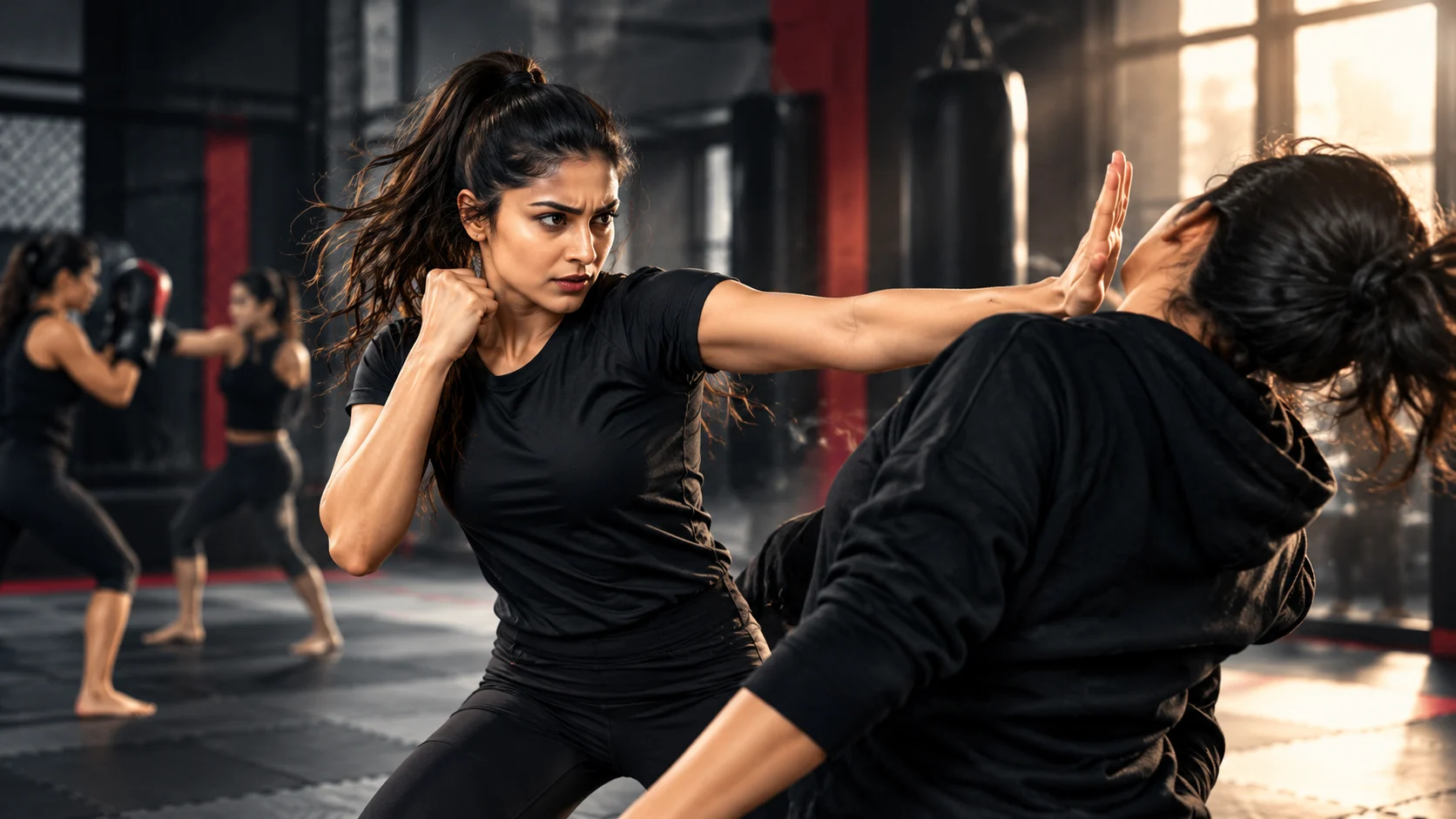
Self-defence training is often associated with learning how to punch, kick or escape from a physical confrontation. But that is only one part of the picture.
For women especially, self-defence training can be about much more: becoming more aware of your surroundings, understanding personal boundaries, improving physical fitness, learning how to stay calm under pressure and developing the confidence to make sensible decisions when something does not feel right.
The goal is not to turn every woman into a fighter.
The goal is to help her become more prepared.
A good self-defence programme starts long before physical contact. Awareness, prevention, communication, distance, movement, escape and knowing when to seek help are all important. UN Women notes that women’s self-defence workshops can help equip women to avoid or counter attacks and build self-defence skills, while also stressing that such training should complement broader violence-prevention efforts rather than replace them.
At Kings Academy of Martial Arts Chandigarh, self-defence training combines elements of MMA, boxing, kickboxing, BJJ and traditional martial arts. The programme covers awareness, prevention, defensive movement, escaping common attacks, grip releases, basic striking, safe falling, ground defence and controlled partner practice.
That makes self-defence useful far beyond the walls of a martial arts academy.
What Is Self-Defence Training?
Self-defence training teaches practical skills and decision-making that can help a person respond to potentially unsafe situations.
It is important to understand what that means.
Self-defence is not about looking for confrontation.
It is about avoiding unnecessary confrontation whenever possible and knowing what to do if a situation becomes unsafe.
A responsible programme can include:
- Situational awareness
- Understanding personal boundaries
- Recognising potentially unsafe situations
- Verbal communication
- De-escalation
- Movement and positioning
- Escape techniques
- Defensive movements
- Basic striking
- Grip-release techniques
- Ground-escape fundamentals
- Safe falling
- Physical conditioning
- Controlled partner drills
- Emergency response awareness
Kings Academy follows a similar approach, describing self-defence as a combination of awareness, prevention, defensive movements, escape techniques and controlled physical training.
This is especially important for beginners.
You do not need to arrive with martial arts experience. You learn progressively.
Why Self-Defence Training Matters for Women
Women can face different safety concerns in different environments, whether travelling alone, walking home, working late, attending college, using public transport or simply dealing with unwanted attention.
Self-defence training cannot guarantee safety, and no technique works in every situation.
But learning how to recognise risk, create distance, communicate clearly and seek help can give a person more options.
That is valuable.
The World Health Organization treats violence against women as a major public-health and human-rights issue and emphasises prevention, empowerment, safer environments and support services as part of a broader response.
Self-defence is therefore best understood as one practical layer of personal safety, not a complete solution to violence against women.
1. Awareness Comes Before Physical Defence
The first lesson in good self-defence training should not be a punch.
It should be awareness.
Where are you?
Who is around you?
What is happening?
Are you becoming uncomfortable?
Is someone repeatedly entering your personal space?
Is there an obvious route toward a safer, more populated area?
Can you call someone?
Can you leave?
These questions matter because avoiding a dangerous situation is generally safer than trying to physically handle it.
Kings Academy’s self-defence programme specifically places awareness and prevention before physical techniques.
That is an important principle for women to understand.
You do not have to wait until something becomes physically dangerous before taking your own discomfort seriously.
2. Self-Defence Can Improve Confidence
Confidence does not mean believing that nothing bad can happen.
It means becoming more comfortable with your ability to think, move and respond.
For many beginners, the first few classes can feel unfamiliar.
You may not know how to stand.
You may find basic movements awkward.
You may hesitate when practising with a partner.
That is normal.
Then you practise.
You learn how to move.
You learn how to maintain balance.
You learn simple defensive movements.
You practise escaping controlled situations.
Gradually, the unfamiliar becomes familiar.
That process can build self-belief.
Kings Academy lists confidence, mental preparedness, quick decision-making and staying calm under stress among the intended outcomes of its self-defence programme.
The confidence developed through training can also influence everyday situations.
It might mean speaking more clearly.
Setting a boundary.
Saying no.
Asking for help.
Walking away from an uncomfortable situation.
Those are not fighting skills.
They are life skills.
3. Self-Defence Training Builds Physical Fitness
There is another advantage that is sometimes overlooked.
You get physically active.
A structured self-defence training session can involve movement drills, footwork, bodyweight exercises, striking practice, defensive movements, coordination drills and conditioning.
That means you are developing more than a technical skill.
You are also using your:
- Legs
- Core
- Shoulders
- Arms
- Back
- Cardiovascular system
- Balance
- Coordination
Regular physical activity has well-established health benefits. WHO recommends that adults aged 18–64 accumulate at least 150 minutes of moderate physical activity each week, or 75 minutes of vigorous activity, along with muscle-strengthening activity on two or more days per week.
A martial arts programme can be one enjoyable way of contributing to an active lifestyle.
And there is an important difference between exercising because you “should” and exercising because you are learning something.
When training has a purpose, it can become easier to stay engaged.
4. It Teaches You to Stay Calm Under Pressure
One of the most useful aspects of martial arts training is controlled pressure.
A beginner may experience a situation during training where the heart rate rises, the body becomes tired and several things have to happen at once.
You have to listen.
Remember the movement.
Keep your balance.
Control your breathing.
Respond to your training partner.
That experience teaches something valuable:
Pressure does not automatically mean panic.
With safe and progressive coaching, you learn to continue thinking while physically challenged.
This does not mean a person will automatically remain calm during a real emergency. Real situations are unpredictable.
But repeated exposure to controlled training can help people become more familiar with the feeling of pressure and uncertainty.
That is one reason self-defence training for women should include both physical practice and decision-making.
5. Learning to Set Boundaries
Personal safety is not only physical.
It is also social.
A woman should not have to physically fight someone before she is allowed to feel uncomfortable.
Learning to recognise and communicate boundaries is an important part of personal safety.
For example:
- “Please give me some space.”
- “I don’t want you to follow me.”
- “No.”
- “I need help.”
- “Please call the police.”
- “I don’t know this person.”
Clear communication can sometimes prevent a situation from escalating.
Self-defence training can reinforce the idea that you are allowed to protect your personal space.
That does not mean every uncomfortable interaction is dangerous.
It means learning to notice when your boundaries are being ignored.
6. Self-Defence Is About Escape, Not Winning
This distinction matters.
In a sports competition, there may be a winner and a loser.
In self-defence, the objective is different.
The objective is to reach safety.
If leaving is possible, leaving is usually preferable to engaging physically.
A responsible self-defence programme should therefore teach people to think about:
- Awareness
- Avoidance
- Distance
- Escape
- Getting help
- Physical defence only when necessary
WHO educational material on violence prevention also distinguishes self-defence from retaliation and describes physical force as a last resort, with the goal of getting away.
This is one of the biggest differences between martial arts as a sport and self-defence as a personal-safety skill.
7. Why Movement Matters
You do not always need to stand directly in front of a person.
Movement can create options.
In training, women can learn basic concepts such as:
- Maintaining balance
- Moving away from pressure
- Creating space
- Changing direction
- Protecting vulnerable areas
- Keeping a stable stance
- Moving toward an exit
- Avoiding being trapped against a wall
These are practical concepts.
They also make training more interesting because you are learning how your body moves rather than simply repeating punches.
At Kings Academy, the self-defence curriculum includes defensive movements, escape techniques, grip releases and controlled partner practice.
8. Grip-Release and Escape Skills
A common misconception is that self-defence always involves striking.
It does not.
Learning how to respond when someone grabs your wrist, clothing or another part of your body can be useful.
In a properly supervised class, these situations can be practised in a controlled environment.
The purpose is not to teach people to hurt others.
It is to develop:
- Awareness
- Positioning
- Balance
- Movement
- Timing
- Escape
- Getting to safety
Kings Academy includes grip-release methods and escape techniques in its self-defence programme.
This type of training is especially useful for beginners because it introduces practical scenarios without immediately moving into advanced combat training.
9. Self-Defence Can Improve Coordination
Try throwing a punch while standing completely still.
Now add footwork.
Then add a defensive movement.
Then change direction.
Suddenly, it becomes much harder.
That is why martial arts can be good coordination training.
Your brain has to communicate with different parts of your body at the same time.
You learn to:
- Move your feet
- Control your hands
- Maintain balance
- Watch movement
- React to cues
- Change direction
- Maintain posture
Over time, this can improve body awareness.
And body awareness is useful outside the academy too.
Walking, climbing stairs, carrying objects, playing sport and performing everyday tasks all depend on coordinated movement.
10. Self-Defence Training Can Become a Long-Term Fitness Habit
The best exercise programme is not necessarily the most complicated one.
It is the one you can continue.
That is where martial arts have an advantage for some people.
Every class gives you something to learn.
There is always another technique.
Another combination.
Another movement.
Another level of conditioning.
Another detail to improve.
That creates a natural reason to keep coming back.
WHO also emphasises that some physical activity is better than none and that people who are inactive should start with smaller amounts and gradually increase frequency, duration and intensity.
You do not need to start with five classes a week.
Start realistically.
Build the habit.
Then progress.
11. Self-Defence for Women Can Support a Healthier Lifestyle
Women often have busy schedules.
Work.
Family.
College.
Travel.
Household responsibilities.
Social commitments.
Finding time for exercise can be difficult.
That is why combining several benefits into one activity can be useful.
A self-defence class can provide:
- Physical activity
- Skill development
- Social interaction
- Mental focus
- Strength work
- Coordination
- Conditioning
- Confidence building
It does not have to replace every other type of exercise.
It can become one part of a balanced routine.
For example:
Monday
Self-defence training
Tuesday
Walking or light mobility
Wednesday
Strength or functional fitness
Thursday
Rest
Friday
Self-defence or martial arts training
Saturday
Outdoor activity
Sunday
Recovery
The exact routine should depend on your fitness level, schedule, age, health and goals.
The principle is simple:
Build a routine you can actually maintain.
12. Why Strength Matters for Women
Strength is not just about appearance.
It helps you carry things.
Move confidently.
Maintain balance.
Perform everyday tasks.
Support physical independence.
Strength training is also part of the broader physical-activity recommendations from WHO, which advise adults to perform muscle-strengthening activities involving major muscle groups on at least two days each week.
Self-defence training can complement that work by adding movement, conditioning and martial arts practice.
For women who have never trained before, this can be an approachable way to begin becoming more physically capable.
13. Self-Defence and the Modern Working Woman
Consider a woman who spends eight or nine hours working at a desk.
She may spend most of the day sitting.
Her work requires concentration but very little physical movement.
After work, she may continue using a phone or laptop.
Self-defence training provides a very different environment.
You stand.
You move.
You sweat.
You focus.
You communicate with other people.
You learn.
You make mistakes.
You try again.
That physical change of environment can be valuable.
Regular physical activity is associated with better physical fitness, mental health, sleep and overall well-being, according to WHO.
So self-defence training for women can be viewed not only as personal-safety education but also as an opportunity to build a more active lifestyle.
14. Self-Defence Training Can Improve Discipline
Traditional martial arts have always placed importance on repetition.
There is a reason.
You cannot master a movement after doing it five times.
You practise.
Again.
And again.
Sometimes hundreds of times.
That process teaches patience.
It also teaches an important life lesson:
Improvement is usually the result of repeated small efforts.
The same principle applies to fitness.
The same principle applies to work.
The same principle applies to learning.
You show up.
You practise.
You improve.
You repeat.
That is discipline.
15. Self-Defence Training and Mental Preparedness
Physical skills are only one part of preparedness.
Mental preparation matters too.
A good class can introduce controlled scenarios that require participants to make decisions while moving.
For example:
- Where is the safest direction to move?
- Can I create distance?
- Is there an exit?
- Should I call for help?
- Can I attract attention?
- Is physical action necessary?
- Can I leave without engaging?
These questions encourage practical thinking.
Kings Academy’s programme includes confidence-building drills and emergency-response techniques alongside physical skills.
The aim is not to make someone constantly fearful.
Quite the opposite.
The aim is to develop awareness without living in fear.
16. Fear and Awareness Are Not the Same Thing
This is an important distinction.
Being aware does not mean assuming everyone around you is dangerous.
It means paying attention.
There is a difference between:
Fear:
“Something bad is definitely going to happen.”
and
Awareness:
“I am paying attention to what is happening around me.”
Healthy self-defence education should encourage awareness without creating unnecessary anxiety.
You can enjoy an evening out.
Travel.
Walk.
Work.
Study.
Meet friends.
Live normally.
You simply become more conscious of your environment and more prepared to make sensible decisions.
17. What Women Can Expect From Their First Class
If you have never attended a martial arts academy, you may feel nervous.
That is normal.
Your first session should not feel like a professional fight camp.
At Kings Academy, beginners can start without previous martial arts experience, and the programme is structured progressively. The academy also offers dedicated women’s batches and describes its environment as safe, supportive and beginner-friendly.
A beginner session may include:
Warm-up
Light movement, mobility and preparation.
Basic stance
Learning how to position your feet and body.
Movement
Simple footwork and balance exercises.
Defensive movement
Learning how to move away from pressure.
Basic techniques
Controlled introduction to suitable striking or escape techniques.
Partner drills
Practising techniques slowly with a partner.
Conditioning
Simple exercises to build fitness.
Cool-down
Recovery and stretching.
The objective is learning, not proving how tough you are.
18. What Should Women Wear to Self-Defence Classes?
You do not need an expensive wardrobe.
Comfortable sportswear is usually enough for a first session.
Choose clothing that allows you to:
- Move your arms freely
- Move your legs comfortably
- Bend and rotate
- Exercise without restriction
Sports shoes may be suitable depending on the class and training surface.
As you continue training, your coach can advise you about gloves, protective equipment and other requirements.
At Kings Academy, the academy states that comfortable workout clothes and sports shoes are sufficient for a first class.
19. How to Choose Self-Defence Classes for Women
Not every class is the same.
Before joining, look at the training environment.
Ask about the coaching
Who is teaching?
What experience do they have?
How do they handle beginners?
Look at the training approach
Does the programme include awareness and prevention?
Or is everything focused on fighting?
Check the environment
Do beginners feel comfortable?
Are women given appropriate support?
Is partner training controlled?
Ask about progression
Does the coach adjust training according to ability?
Look at safety
Are techniques taught progressively?
Are students encouraged to avoid unnecessary confrontation?
These questions matter more than flashy demonstrations.
Kings Academy highlights experienced coaching, beginner-friendly classes, separate women’s and kids’ batches, small batch sizes, practical techniques and a supportive environment.
20. Self-Defence Is Not a Guarantee of Safety
This point should never be ignored.
No self-defence class can guarantee that someone will be able to prevent or escape every dangerous situation.
Real-world violence is unpredictable.
Physical size, surroundings, multiple people, weapons, surprise, injuries and many other factors can change a situation completely.
That is why good self-defence training should teach people to avoid danger where possible and seek help rather than creating a false sense of invincibility.
UN Women specifically notes that women’s self-defence workshops can be useful but are not a replacement for wider violence-prevention strategies.
Training gives you additional knowledge and options.
It does not remove uncertainty.
21. Self-Defence, Fitness and Everyday Health
There is another reason to look at self-defence as part of a lifestyle.
Your health is built from everyday decisions.
Movement.
Sleep.
Food.
Stress management.
Social connection.
Recovery.
Consistency.
WHO’s current guidance describes physical activity as an important part of maintaining health and well-being and notes benefits for physical fitness, mental health, sleep and quality of life.
That means you do not need to think of self-defence training as something completely separate from your health.
It can be one piece of the bigger picture.
And sometimes the smallest habits become the most sustainable ones.
Even everyday questions about lifestyle and nutrition such as does english breakfast tea have caffeine can be part of the wider conversation about understanding what you consume, how you train and how you build healthier daily routines.
22. The Long-Term Impact of Self-Defence Training
The first few classes may produce physical changes.
You may sweat more.
Your muscles may feel tired.
Your coordination may improve.
But the bigger changes often happen gradually.
After several months, you may become more comfortable with physical activity.
After a year, you may look back and realise how much your movement has changed.
After several years, training may simply become part of who you are.
You do not think about whether you should train.
Training is simply something you do.
That is the real value of a long-term approach.
A Simple Long-Term Plan for Women
If you are completely new to self-defence training, start slowly.
First Month: Learn
Focus on:
- Awareness
- Basic movement
- Balance
- Stance
- Simple defensive techniques
- Communication
- Escape principles
Do not worry about advanced techniques.
Months 2–3: Build
Start developing:
- Better coordination
- Stronger movement
- Improved conditioning
- More confidence
- Faster reactions
- Better understanding of distance
Months 4–6: Develop
Training can become more challenging as your coach considers your experience and readiness.
You may work on:
- More complex movement
- Controlled partner drills
- Scenario-based exercises
- Fitness conditioning
- Defensive combinations
- Greater movement efficiency
Six Months and Beyond: Maintain
This is where training becomes a lifestyle.
Continue learning.
Continue improving.
Continue staying active.
Do not measure everything by how hard you can hit.
Measure progress by how much better you understand movement, awareness, control and your own capabilities.
Self-Defence Training Beyond the Gym
The most valuable part of self-defence training may not be the technique itself.
It may be what you learn about yourself.
You learn that being uncomfortable does not mean you cannot continue.
You learn that mistakes are part of learning.
You learn to listen.
You learn to stay patient.
You learn to pay attention.
You learn to respect boundaries.
You learn to control your emotions.
You learn that physical strength is useful, but awareness and judgement matter too.
Those lessons can follow you into everyday life.
At work.
At college.
While travelling.
At home.
When meeting new people.
When dealing with pressure.
When making difficult decisions.
That is why self-defence belongs beyond the gym.
Why Women Should Consider Making Self-Defence a Habit
You do not have to train because you are afraid.
Train because you want to be capable.
Train because you want to move better.
Train because you want to become stronger.
Train because you want to learn a practical skill.
Train because you want to challenge yourself.
Train because you want to feel more comfortable in your own body.
Train because you want an active lifestyle.
And yes, train because knowing what to do in an uncomfortable situation can be useful.
There is no single reason.
There does not need to be.
Final Thoughts
Self-defence training is useful beyond the gym because the lessons do not stay inside the training room.
You learn awareness.
You learn movement.
You learn discipline.
You improve physical fitness.
You practise decision-making.
You become more familiar with controlled pressure.
You develop confidence through repetition.
Most importantly, you learn that personal safety is not only about fighting.
It starts with awareness.
Then prevention.
Then communication.
Then creating distance.
Then finding a safe way out.
Physical defence is only one possible part of the process.
For women, this approach can make self-defence training a practical part of a healthy and confident lifestyle rather than simply another workout.
At Kings Academy of Martial Arts Chandigarh, the women’s self-defence programme combines practical self-protection skills with fitness, awareness, confidence-building and controlled martial arts training. The academy offers dedicated women’s programmes alongside MMA, boxing, kickboxing, BJJ and other martial arts disciplines.
You do not need to be strong before you start.
You become stronger by starting.
You do not need confidence before your first class.
Confidence can grow through learning.
And you do not need to become a fighter.
You simply need to become a little more prepared, a little more aware and a little more capable than you were yesterday.
That is what good self-defence training for women should ultimately be about.
Awareness first. Confidence second. Physical skills when necessary. Safety always.