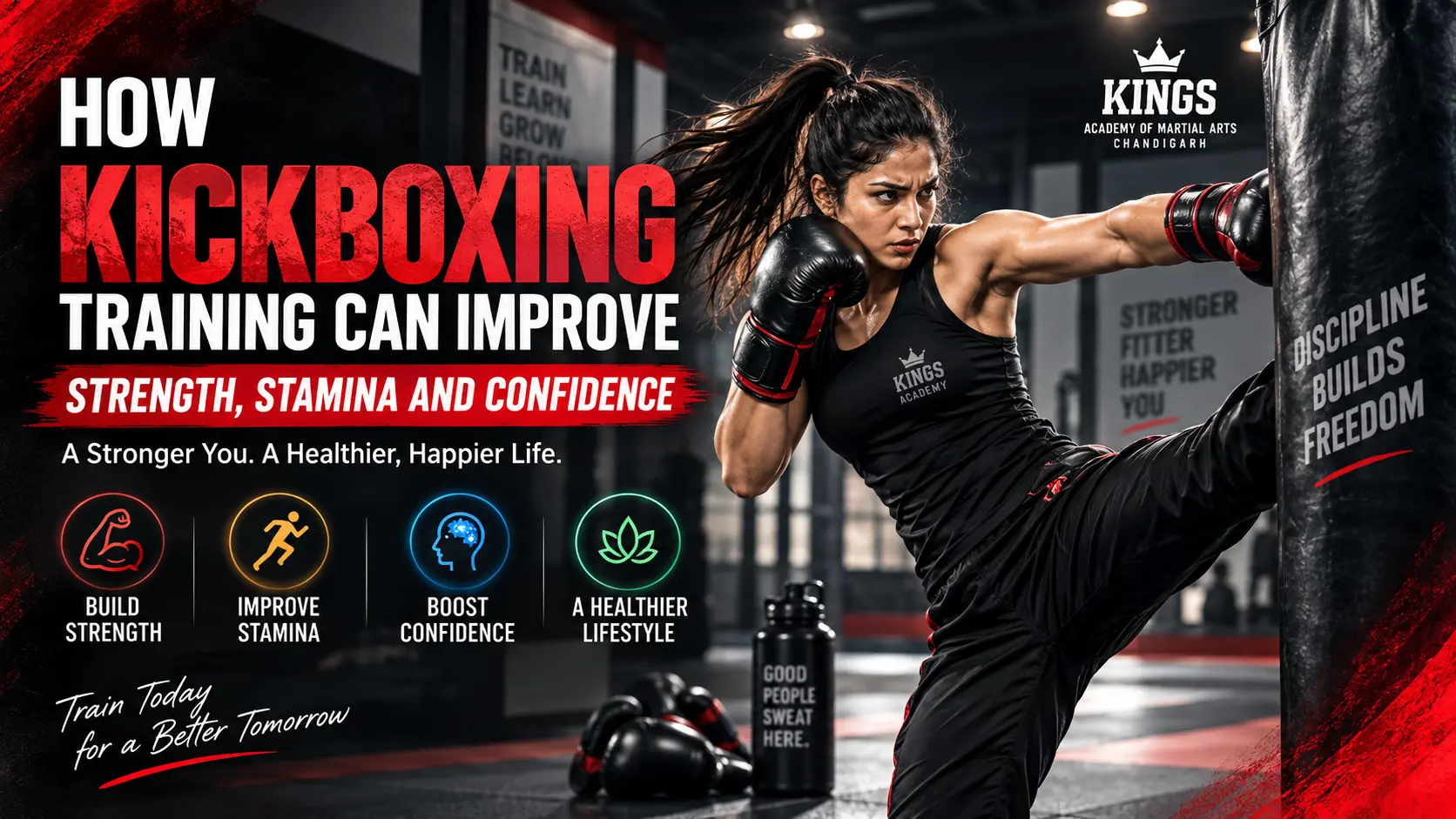
There is something different about training with a purpose.
A traditional workout can make you sweat. A good kickboxing session makes you move, think, react, remember, control your breathing, use your whole body and stay focused on what you are doing.
That is one reason kickboxing training has become more than a combat sport for many people. It can be a practical way to build fitness while learning a skill that requires patience, discipline and consistency.
You do not have to dream about becoming a professional fighter. You do not need to walk into a gym already strong or athletic. And you certainly do not need to prove anything to anyone.
You can start simply because you want to feel better, move better and become stronger.
Over time, that simple decision can become a long-term lifestyle habit.
At Kings Academy of Martial Arts Chandigarh, kickboxing training combines punching, kicking, footwork, defensive movement, combinations, pad work, bag work, conditioning, coordination and mobility. Beginners are introduced to the fundamentals step by step before progressing to more demanding combinations and conditioning.
But the real value goes beyond what happens during one class.
The strength you build can make everyday movement easier. Better stamina can help you get through a long working day without feeling completely drained. Improved coordination can make you more comfortable in your own body. And the discipline of showing up, practising and improving can gradually influence how you approach work, responsibilities and other challenges.
That is where kickboxing training becomes a lifestyle rather than simply another workout.
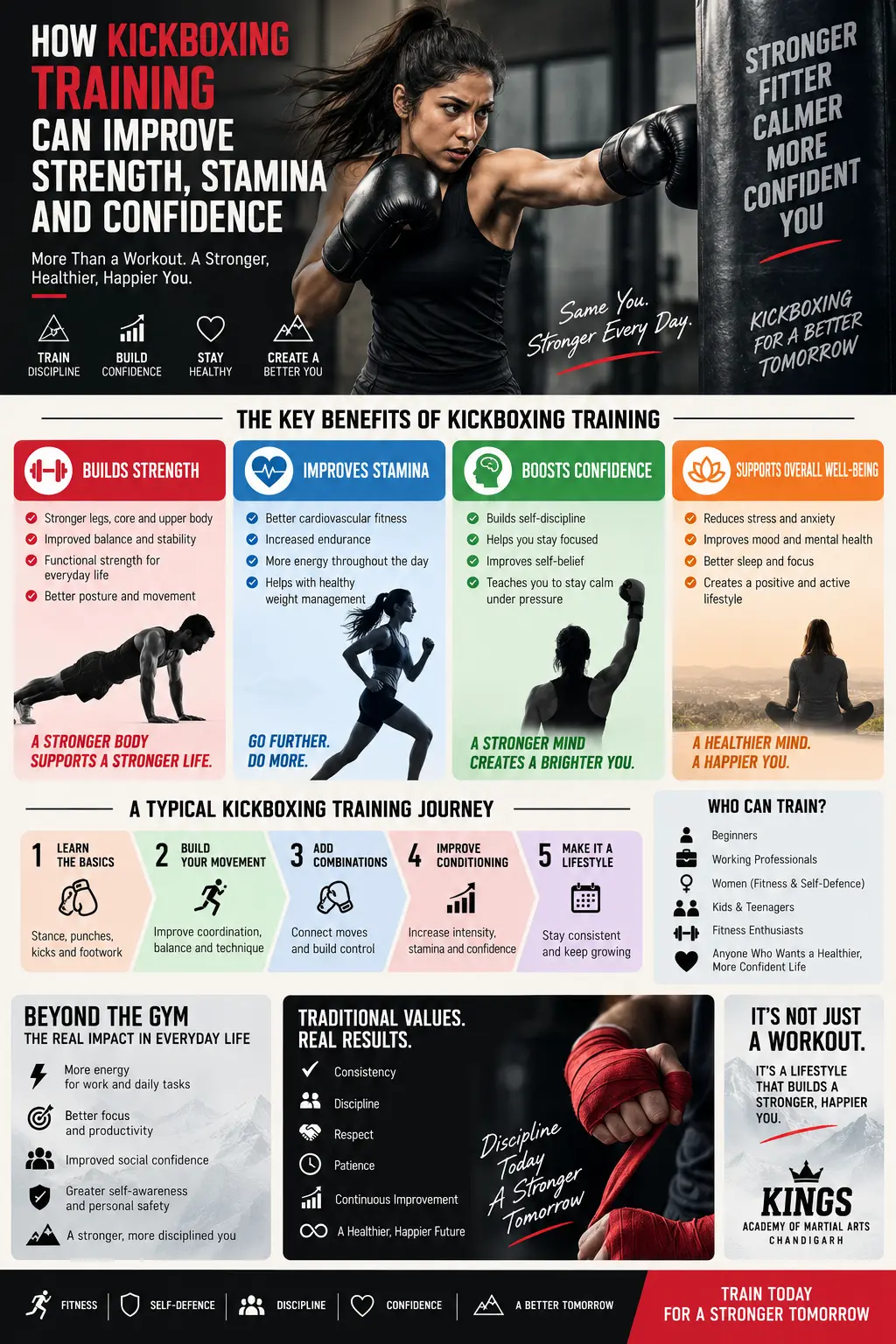
What Is Kickboxing Training?
Kickboxing is a striking-based martial art that combines punches, kicks, movement, defensive techniques and conditioning.
A well-structured class is not simply about hitting a bag as hard as possible.
Students may work on:
- Stance and balance
- Footwork
- Punching techniques
- Kicking techniques
- Punch and kick combinations
- Defensive movements
- Pad work
- Heavy bag training
- Speed and reaction drills
- Coordination
- Mobility and flexibility
- Strength and conditioning
- Cardio and endurance
- Controlled partner drills
- Sparring for suitable and experienced students
The exact structure depends on the student’s experience, goals and readiness. Beginners should first learn how to move correctly before worrying about speed or power.
That traditional approach matters.
Good martial arts are built on fundamentals. You learn the stance. You learn the movement. You repeat the technique. You make mistakes. You correct them. You repeat again.
There is no shortcut.
And that is actually one of the most useful lessons of kickboxing training.
Why Kickboxing Training Is More Than Exercise
Modern life can make physical activity strangely difficult.
Many people spend hours sitting at a desk, travelling by car, working on a laptop, attending meetings or looking at screens. Even when someone wants to exercise, the biggest challenge is often finding a form of exercise they actually enjoy enough to continue.
The World Health Organization recommends that adults accumulate at least 150–300 minutes of moderate aerobic activity per week, or 75–150 minutes of vigorous aerobic activity, along with muscle-strengthening activity on at least two days each week. It also emphasises that some activity is better than none and that inactive people should build up gradually.
Kickboxing can become one part of that active lifestyle.
Instead of spending every session doing the same machine-based exercises, you are learning a physical skill while working your cardiovascular system, coordination, balance, mobility and muscular endurance.
That combination can make training more engaging.
And when exercise is something you look forward to rather than something you constantly force yourself to do, consistency becomes easier.
How Kickboxing Training Builds Strength
Strength is not only about lifting the heaviest weight in a gym.
Real-world strength also involves how well your body can produce force, maintain position, control movement and repeat physical effort.
Kickboxing uses the entire body.
A punch begins with the ground and moves through the legs, hips, torso, shoulder and arm. A kick requires balance, hip movement, core control and coordination. Footwork requires the legs to repeatedly move, stop, change direction and stabilise the body.
During a properly planned class, exercises may also include bodyweight movements, conditioning drills and other strength-focused exercises.
This creates a different type of physical challenge.
1. Lower-body strength
Kicks and footwork require repeated work from the legs and hips.
You are constantly controlling your stance, shifting weight and maintaining balance.
Over time, consistent training can help develop stronger and more capable lower-body movement.
2. Core strength
Your core plays an important role in transferring force between the lower and upper body.
A controlled punch, kick or defensive movement is not just an arm or leg movement. Your torso has to remain stable while the rest of the body moves.
That makes core control an important part of good technique.
3. Upper-body conditioning
Punch combinations and pad or bag work repeatedly challenge the shoulders, arms and upper body.
The objective should not be simply to swing harder.
Technique comes first.
As technique improves, students can gradually work on speed, combinations and conditioning.
4. Functional strength
This is where martial arts can feel different from isolated exercises.
You are not simply training one muscle at a time. You are teaching your body to coordinate several parts together.
That can be useful outside the academy too.
Picking something up, climbing stairs, carrying bags, moving furniture or simply maintaining good posture during a long day all involve coordinated movement.
How Kickboxing Training Improves Stamina
Strength allows you to produce force.
Stamina helps you keep going.
A kickboxing class can involve repeated rounds of movement, combinations, footwork, pad work, bag work and conditioning. Your heart and lungs have to support repeated effort while your muscles continue working.
Over time, regular physical activity improves cardiorespiratory and muscular fitness. WHO notes that regular physical activity can improve muscular and cardiorespiratory fitness, help maintain healthy body weight and support mental well-being.
Stamina is useful beyond training
Imagine two people finishing a long working day.
One has spent months building a regular exercise routine.
The other has remained mostly inactive.
Their energy levels will obviously depend on many factors, including sleep, nutrition, stress and individual health. But maintaining regular physical activity gives the body a better foundation for handling everyday physical demands.
That is one of the long-term benefits of kickboxing training.
You are not training only for the 60 minutes inside the academy.
You are training for the rest of the day.
Kickboxing Training and Cardiovascular Fitness
Kickboxing can be physically demanding because it combines repeated movement with periods of higher effort.
Footwork, combinations, pad rounds and conditioning can elevate the heart rate and challenge cardiovascular endurance.
This is especially useful for people who find traditional cardio boring.
Instead of simply running on a treadmill and watching the clock, you have a skill to focus on.
You might be thinking:
Where is my foot?
What comes next?
Am I breathing correctly?
Can I maintain my stance?
Can I complete the combination without losing balance?
That mental involvement makes the workout feel different.
The body is working hard, but the mind is working too.
How Kickboxing Training Can Improve Coordination
Coordination is one of the less obvious benefits of martial arts.
A beginner may initially find it difficult to combine a punch, step and kick.
That is normal.
The brain and body are learning a new movement pattern.
With repetition, those movements gradually become more natural.
Kickboxing training can involve:
- Hand-eye coordination
- Foot-eye coordination
- Balance
- Timing
- Reaction
- Body awareness
- Spatial awareness
- Movement control
These abilities are useful outside sport.
Better coordination can make everyday movement feel more controlled and confident.
It can also help you become more aware of how your body moves.
How Kickboxing Training Can Build Confidence
Confidence is often misunderstood.
It is not about believing you are better than everyone else.
Real confidence is quieter.
It comes from knowing that you can learn something difficult, make mistakes and keep going.
That is exactly what happens in martial arts.
Your first combination may feel awkward.
Your first round may leave you tired.
You may forget techniques.
You may lose your balance.
You may struggle with a movement that looks easy when someone else performs it.
Then you practise.
A few weeks later, that same movement feels easier.
A few months later, you may perform it without thinking about every individual step.
That experience creates something important:
evidence that you can improve.
And that lesson can travel outside the gym.
The Confidence You Build Can Carry Into Work and Daily Life
This is one of the strongest reasons to approach kickboxing training as a lifestyle rather than a short-term fitness challenge.
A working professional may spend most of the day dealing with deadlines, emails, meetings and responsibilities.
Training gives you a completely different environment.
You have to put your phone away.
You have to pay attention.
You have to listen.
You have to move.
You have to remember.
You have to accept correction.
You have to finish the session.
That routine can create a useful mental reset.
Kings Academy specifically highlights the connection between training and everyday life, including better focus, discipline, energy, confidence and stress release.
The lesson is simple:
showing up matters.
Discipline: The Traditional Value That Still Works
Fitness trends change every few months.
The basics do not.
Train consistently.
Eat sensibly.
Sleep properly.
Recover.
Practise your fundamentals.
Respect your coach.
Respect your training partners.
Keep improving.
These are old principles, but they still work.
You do not need a complicated lifestyle transformation.
A person who trains consistently two or three times a week for years will generally build a very different relationship with fitness than someone who trains intensely for three weeks and disappears for six months.
The goal should not always be maximum intensity.
The goal should be long-term consistency.
Kickboxing Training and Stress
Physical activity can also support mental well-being. WHO reports that regular physical activity can improve mental health and well-being and reduce symptoms associated with depression and anxiety.
Kickboxing offers another useful element: concentration.
When you are practising combinations, you cannot spend the entire session thinking about yesterday’s problem or tomorrow’s meeting.
You have to be present.
Left.
Right.
Move.
Defend.
Breathe.
Reset.
Repeat.
That focused environment can provide a useful break from screens and daily responsibilities.
It does not replace professional mental-health care when that is needed, but regular physical activity can be an important part of a healthy lifestyle.
Kickboxing Training for Weight Management and Fitness
Weight management is another reason people become interested in kickboxing training.
A kickboxing session can combine cardio, movement, conditioning and resistance from body movement. The total energy expenditure varies considerably depending on the person’s body size, fitness level, session intensity and duration.
It is therefore better to think about kickboxing as part of an overall lifestyle rather than promising a specific amount of weight loss.
A sensible plan combines:
- Regular training
- Balanced nutrition
- Adequate protein and whole foods
- Good hydration
- Proper sleep
- Recovery
- Daily movement
- Consistency over time
There is no magic workout.
The traditional answer is still the best one:
move regularly, eat sensibly and stay consistent.
What Does a Good Kickboxing Training Plan Look Like?
Beginners often make the mistake of doing too much too quickly.
You do not need to train every day.
You need a routine that you can maintain.
A simple weekly structure could look like this:
Monday — Kickboxing Training
Focus on technique, stance, footwork, combinations and controlled conditioning.
Tuesday — Recovery and Light Movement
Walking, mobility work or gentle stretching.
Wednesday — Kickboxing Training
Technique, pad work, bag work, combinations and conditioning.
Thursday — Recovery
Allow your body to recover while maintaining normal daily movement.
Friday — Kickboxing or Fitness Training
Depending on your experience, this can include technique, conditioning, strength work or a structured class.
Saturday — Active Lifestyle
Walking, cycling, recreational sport or another activity you enjoy.
Sunday — Rest and Recovery
Give the body time to recover.
This is only an example, not a universal prescription. Training frequency should be adjusted according to age, experience, fitness level, goals, recovery and any medical considerations.
WHO also recommends that people who are inactive begin with smaller amounts of activity and gradually increase duration, frequency and intensity.
Your First Month of Kickboxing Training
The first month should not be about trying to become a fighter.
It should be about learning.
Week 1: Learn the basics
Focus on:
- Stance
- Guard
- Basic punches
- Basic kicks
- Footwork
- Breathing
- Balance
Do not worry about speed.
Week 2: Build movement
Start connecting basic movements.
Learn how to move while maintaining your stance.
Week 3: Add combinations
Begin working on simple punch and kick combinations.
The goal is control.
Week 4: Improve conditioning
As your technique becomes more comfortable, conditioning can gradually become more challenging.
This gradual approach is important because good kickboxing training is not about exhausting yourself every session.
It is about becoming better.
What Changes After Three to Six Months?
Everyone progresses differently, so there is no fixed timeline.
But with regular training, you may begin noticing changes in several areas.
Physically
You may notice:
- Better stamina
- Improved coordination
- Greater movement control
- Better conditioning
- Increased strength
- Improved mobility
- Greater comfort with physical activity
Mentally
You may notice:
- Better concentration
- Greater patience
- More discipline
- Increased self-belief
- Better ability to stay focused under pressure
The World Health Organization recognises regular physical activity as beneficial for physical fitness, mental health, cognitive health and overall well-being.
In everyday life
You may simply feel more comfortable being active.
That is an underrated result.
Fitness should not only be something you display in a gym.
It should help you live better.
Kickboxing for Working Professionals
For people working long hours, kickboxing training can be a practical way to create a clear boundary between work and personal time.
Instead of finishing work and immediately moving from one screen to another, training gives you an opportunity to physically reset.
You have to leave the desk.
You have to move.
You have to focus.
And when the session ends, you go home knowing you did something for yourself.
Kings Academy’s kickboxing program specifically connects training with work-life benefits such as improved energy, focus, discipline and stress release.
That makes the activity particularly relevant for people with desk-based jobs.
Kickboxing and Self-Defense Awareness
Kickboxing can develop useful physical skills such as balance, movement, distance awareness, defensive movement and controlled striking.
But martial arts training should not encourage people to look for fights.
Good self-defence starts with awareness and avoidance.
The dedicated self-defense approach at Kings Academy combines elements from MMA, boxing, kickboxing, BJJ and traditional martial arts, with emphasis on awareness, defensive movement, escape techniques and controlled practice.
Kickboxing can therefore complement self-defense training, but the two should not be treated as exactly the same thing.
The objective of self-defense is personal safety.
The objective of kickboxing training can include fitness, skill development, sport, conditioning and confidence.
Is Kickboxing Suitable for Beginners?
Yes.
You do not need to arrive already fit.
You do not need previous martial arts experience.
You do not need to know how to punch or kick correctly.
That is what the class is for.
At Kings Academy, beginner MMA and kickboxing training starts with fundamental movement and gradually introduces combinations, defensive movements, partner drills and conditioning.
The most important quality for a beginner is willingness to learn.
Come in.
Listen.
Practise.
Ask questions.
Make mistakes.
Keep going.
Kickboxing for Women
Kickboxing can provide women with a structured way to improve fitness, movement, confidence and striking skills.
It can also be combined with dedicated self-defense training for a broader approach to personal awareness and safety.
Most importantly, beginners should not feel that they need to be physically strong before starting.
Strength and conditioning are part of what training is designed to develop.
A good training environment should allow beginners to learn without unnecessary pressure.
Kickboxing for Kids and Teenagers
For younger students, training should always be age-appropriate and properly supervised.
The focus should not simply be on fighting.
It should include:
- Coordination
- Discipline
- Focus
- Fitness
- Respect
- Patience
- Confidence
- Self-control
Regular physical activity is particularly important during childhood and adolescence. WHO recommends at least 60 minutes of moderate-to-vigorous physical activity each day for children and adolescents aged 5–17, including muscle- and bone-strengthening activities at least three days per week.
Kickboxing can be one enjoyable component of an active lifestyle when appropriately coached.
What About Online Kickboxing Training?
Not everyone can attend an academy every day.
People travel.
Work schedules change.
Students move between cities.
That is where online training can help maintain consistency.
Kings Academy also provides online fitness and martial arts training that can incorporate footwork, shadowboxing, punching combinations, kicking technique, mobility, conditioning and guided fitness drills.
Online training cannot completely replace the experience of in-person coaching, especially for partner work and supervised sparring.
But it can help people keep moving when attending an academy is not practical.
And consistency matters.
How to Make Kickboxing a Long-Term Lifestyle
This is perhaps the most important part.
Do not build your routine around motivation.
Motivation comes and goes.
Build your routine around habit.
Choose training days.
Put them in your calendar.
Prepare your clothes beforehand.
Keep your equipment ready.
Track your progress.
Sleep properly.
Eat well.
Take recovery seriously.
And most importantly, do not quit because progress becomes slower.
The early improvements can come quickly.
Later, progress may become less obvious.
That is normal.
Sometimes progress is not learning a flashy new combination.
Sometimes it is simply being able to complete the same session with better breathing.
Sometimes it is better footwork.
Sometimes it is recovering faster.
Sometimes it is having the discipline to show up after a difficult day.
That is real progress.
The Long-Term Impact of Kickboxing Training
A healthy lifestyle does not need to be complicated.
Walk more.
Move regularly.
Train your body.
Eat sensible food.
Sleep enough.
Spend time away from screens.
Learn something difficult.
Stay connected with people.
Keep improving.
Kickboxing can fit naturally into that kind of lifestyle.
Over the long term, regular physical activity is associated with improved physical fitness, cardiovascular health, healthy weight management, mental well-being and quality of life.
The important word is regular.
One hard workout does not transform your life.
One class does not make you fit.
One difficult round does not build lasting confidence.
But hundreds of ordinary training sessions can.
That is how a lifestyle is built.
Why Traditional Training Values Still Matter
There is a reason martial arts have traditionally placed so much emphasis on discipline and repetition.
The basics matter.
Respect matters.
Patience matters.
Consistency matters.
You learn before you rush.
You control your movement before you chase power.
You build your foundation before trying to perform advanced techniques.
That approach works surprisingly well outside martial arts too.
In work, you learn the fundamentals before taking on bigger responsibilities.
In business, you build systems before trying to scale.
In education, you understand the basics before moving to advanced subjects.
Fitness is no different.
Build the foundation first.
Then build on it.
Final Thoughts
Kickboxing training can improve strength, stamina and confidence, but its value does not stop when the class ends.
The bigger benefit can be the lifestyle it encourages.
You become more comfortable with movement.
You learn to work through difficult moments.
You become more aware of your body.
You learn to control your breathing.
You practise discipline.
You build physical capacity.
You spend less time sitting.
You create time for yourself.
And gradually, those small habits can influence how you approach everyday life.
At Kings Academy of Martial Arts Chandigarh, kickboxing is taught as a structured discipline for beginners, fitness enthusiasts and experienced students, with training that can include technique, footwork, pad work, bag work, conditioning, mobility and controlled partner work.
You do not have to wait until you are fit to begin.
You do not have to become a fighter.
You do not have to be confident on day one.
Start where you are.
Learn the basics.
Train consistently.
Let the fitness, strength, stamina and confidence come with the process.
Because the best training is not always the training that leaves you exhausted.
It is the training you can keep doing.
And years from now, that consistency can matter far more than one intense workout ever could.