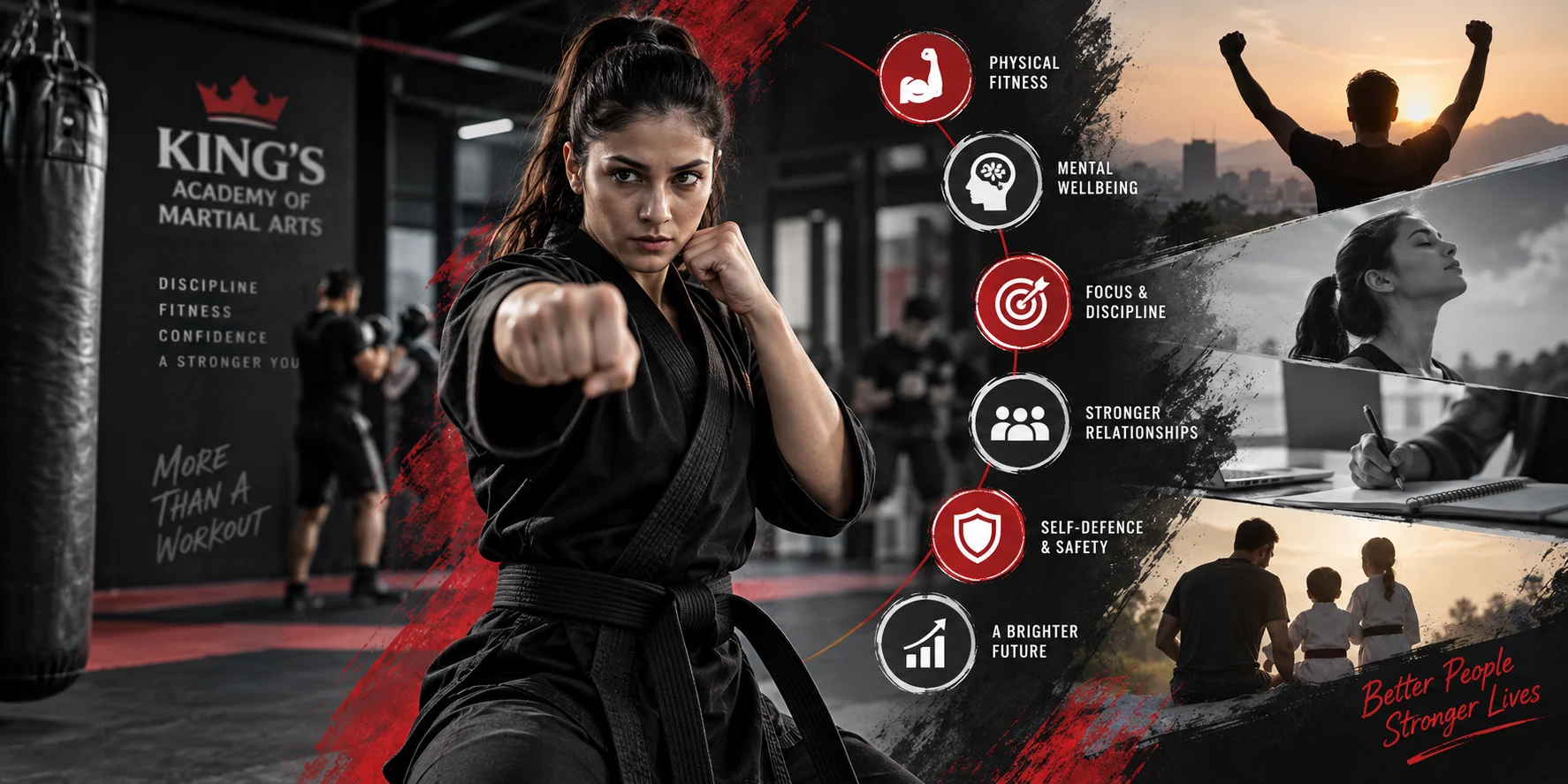
Martial arts have been practised for generations for a simple reason: they teach the body to move with purpose and the mind to stay under control.
Today, martial arts are often associated with competition, fighting, fitness or self-defence. But there is another side that is just as important — and perhaps more valuable over the long term.
Martial arts training can become a way of life.
You learn how to move better. You become more aware of your body. You learn to listen, repeat, make mistakes, correct them and try again. Over time, the lessons learned inside the training hall can begin to appear outside it at work, at school, at home and in everyday situations.
That is what makes martial arts different from simply exercising for a few weeks or following a short fitness programme.
A good martial arts programme is built around practice, patience, discipline and consistency.
It does not promise overnight transformation. Instead, it encourages gradual improvement.
And that is exactly why martial arts can have such a meaningful long-term impact on everyday life.
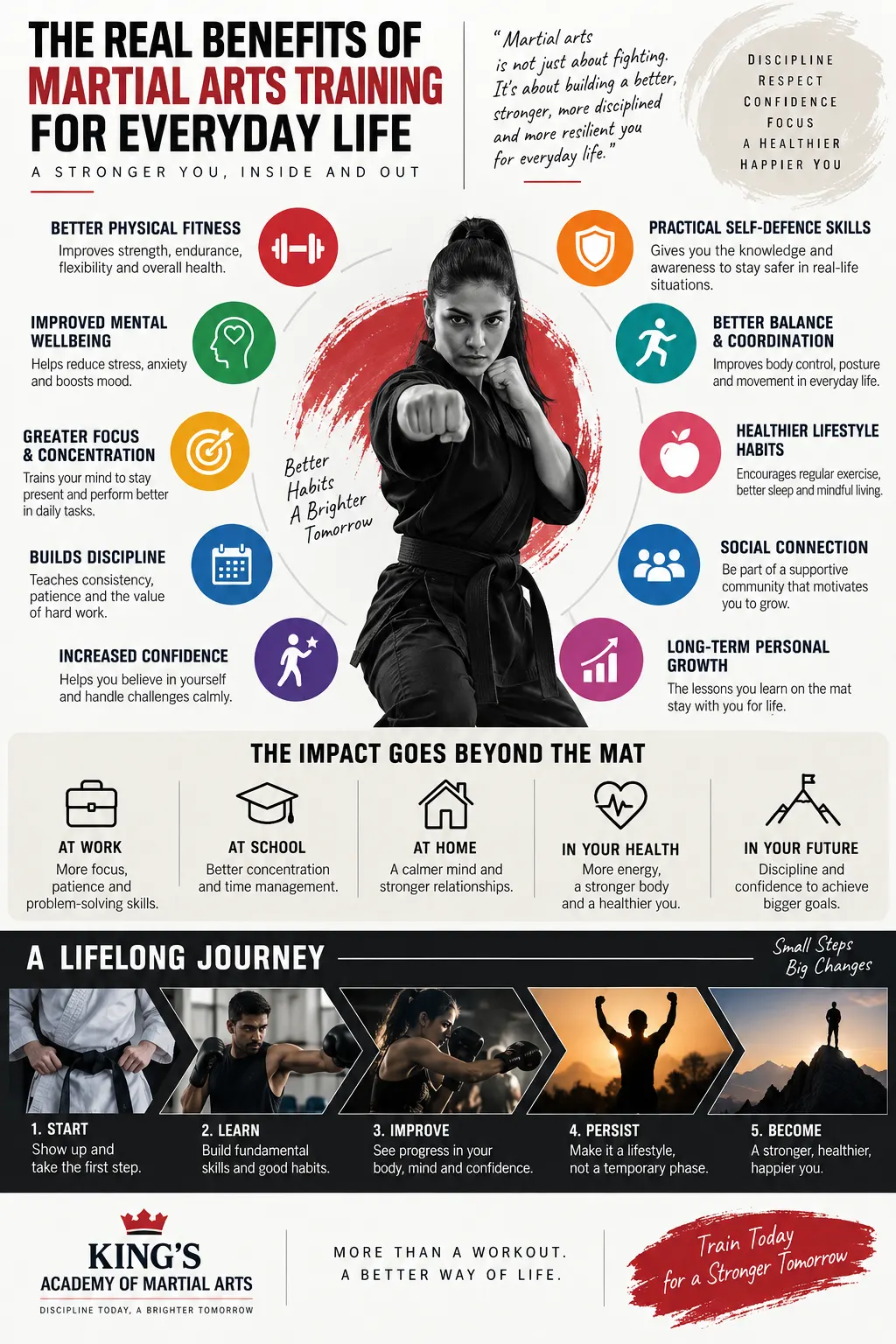
What Makes Martial Arts Different From Ordinary Exercise?
Any regular physical activity can be valuable. Walking, running, cycling, strength training, swimming and sports can all contribute to better physical and mental health.
The World Health Organization recommends regular physical activity because it supports cardiovascular health, physical fitness, mental wellbeing and the prevention and management of several chronic diseases. It also emphasises that every movement counts and that some physical activity is better than none.
Martial arts add another layer.
Instead of simply moving for a set amount of time, you are usually learning something while you move.
You may be practising:
- Footwork
- Balance
- Coordination
- Punches and kicks
- Defensive movement
- Combinations
- Timing
- Reaction
- Controlled breathing
- Partner drills
- Strength and conditioning
- Mobility
- Technical skills
- Discipline and etiquette
You are not just trying to become tired.
You are trying to become better.
That distinction matters.
When training has a skill component, there is always something new to work on. A movement that feels awkward during the first few sessions may eventually become natural. A combination that seems difficult today may become automatic after weeks of practice.
That process encourages patience.
And patience is useful far beyond the gym.
1. Martial Arts Help Build a Stronger and More Active Body
The most obvious benefit of martial arts training is physical.
Depending on the discipline and training style, a martial arts session can involve cardiovascular work, muscular endurance, strength, flexibility, balance, coordination and repeated movement.
Research examining martial arts participation has found positive effects across several areas of physical fitness. A systematic review involving children found improvements in areas such as cardiorespiratory fitness, speed, agility, strength, flexibility, coordination and balance across several martial arts programmes.
For adults, reviews have also reported potential benefits involving cardiovascular fitness, balance, muscular and skeletal health, psychological health and metabolic factors, although researchers note that the quality and design of studies vary.
That matters because everyday health is not about having one impressive fitness quality.
You need a body that can do ordinary things well.
Walking up stairs.
Carrying groceries.
Sitting and standing comfortably.
Moving quickly when necessary.
Maintaining balance.
Having enough stamina to get through a busy day.
Being physically capable does not mean becoming a professional fighter.
It means building a body that is prepared for life.
Strength Is Useful Outside the Training Hall
Strength is often associated with lifting heavy weights, but practical strength is broader than that.
Martial arts can challenge the muscles through bodyweight movements, resistance drills, striking, grappling, controlled partner work and conditioning exercises.
Over time, consistent training can help develop better muscular endurance and general physical capability.
The real value comes from consistency.
One hard session will not transform your body.
One week will not change your lifestyle.
But training regularly for months and years can create a very different level of physical fitness.
That is the traditional approach to training:
Show up. Practise. Recover. Repeat.
2. Better Balance, Coordination and Body Awareness
One of the underrated benefits of martial arts is learning how to control your body.
A punch is not simply an arm movement.
A kick is not simply lifting the leg.
Good technique involves posture, balance, timing, distance, coordination and controlled movement.
You begin to understand where your hands and feet are in relation to your body.
This is called body awareness, and it becomes particularly useful as training progresses.
You may notice that you stand differently.
You may become more aware of your posture.
You may react more quickly when you lose balance.
You may become more comfortable moving in different directions.
These skills are not only useful during training.
Balance and coordination are part of everyday physical independence, particularly as people get older.
Research on martial arts has identified potential benefits related to balance and cognitive function, although researchers also emphasise the need for stronger long-term studies.
The lesson is simple:
A strong body is useful. A controlled body is even more useful.
3. Martial Arts Can Support Better Mental Wellbeing
The body and mind are not separate machines.
When you move regularly, learn physical skills and maintain a routine, your mental state can also benefit.
The WHO reports that regular physical activity can improve mental wellbeing and reduce symptoms associated with depression and anxiety.
Research specifically examining martial arts has also found encouraging results.
A systematic review and meta-analysis of martial arts training found a small positive effect on wellbeing and a moderate effect on internalising mental-health outcomes, although the researchers noted variation between studies.
That does not mean martial arts should be treated as a replacement for professional mental-health care.
It does mean that regular training can become one useful part of a healthy lifestyle.
There is something mentally refreshing about stepping away from a phone, computer, office or classroom and concentrating on movement.
For one hour, the task is simple:
Listen.
Move.
Practise.
Correct.
Try again.
That kind of focused attention can be valuable in a world where people are constantly interrupted.
4. Discipline: The Benefit That Stays With You
This may be one of the biggest long-term benefits of martial arts.
Fitness can change.
Weight can fluctuate.
Strength can rise and fall.
But discipline is a skill that can be carried into almost every part of life.
Martial arts teach discipline through repetition.
You do not become good at a technique because you watched someone perform it once.
You practise.
Then you practise again.
Sometimes the improvement is obvious.
Sometimes it is barely noticeable.
You still come back.
That teaches an important lesson:
Progress does not always feel like progress while it is happening.
The same principle applies to studying, business, career development, learning a skill or building a healthy routine.
You do not need to be motivated every day.
You need to develop the habit of showing up.
That is where martial arts can have an impact far beyond physical fitness.
5. Learning to Stay Calm Under Pressure
A controlled training environment can teach you how to remain composed when something does not go according to plan.
You may forget a combination.
You may lose your balance.
You may struggle with a drill.
You may face a more experienced training partner.
The answer is not to panic.
You breathe.
You listen.
You reset.
You try again.
That process can gradually develop composure.
Research into martial arts and mental health in adults has found some evidence of positive associations with wellbeing and certain cognitive abilities, while also noting that the overall evidence remains mixed and that results differ according to training type, experience and other factors.
So it would be wrong to say that martial arts automatically make everyone calm.
But a well-structured class gives people repeated opportunities to practise staying controlled in challenging situations.
That is a useful life skill.
6. Confidence Without Arrogance
There is a major difference between confidence and aggression.
Traditional martial arts have long placed importance on respect, control and responsibility.
Good training should not teach a person to look for fights.
It should teach them to understand their ability and, more importantly, understand when not to use it.
As your skills improve, you may become more comfortable with your physical abilities.
You know what your body can do.
You know what you still need to improve.
You become less concerned with proving yourself every time someone challenges you.
That is a healthier form of confidence.
Real confidence does not need to be loud.
It can simply mean knowing that you have worked hard, learned a skill and can handle yourself responsibly.
7. Martial Arts Can Teach Patience
Modern life encourages immediate results.
People want faster weight loss.
Faster career growth.
Faster fitness.
Faster learning.
Martial arts work differently.
You might spend weeks improving a movement that looks simple.
A coach may correct the same mistake repeatedly.
You may perform hundreds of repetitions before a technique begins to feel natural.
That can be frustrating.
It can also be valuable.
You learn that some things cannot be rushed.
Strength takes time.
Skill takes time.
Fitness takes time.
Confidence takes time.
Discipline takes time.
That traditional approach is increasingly valuable in everyday life because it teaches people to respect the process instead of constantly chasing the next shortcut.
8. Better Focus and Concentration
A martial arts class requires attention.
You have to listen to instructions.
Remember techniques.
Watch demonstrations.
Follow combinations.
Respond to your training partner.
Maintain your stance.
Control your movement.
There is very little room for completely switching off.
Some research on martial arts and combat sports has found evidence of positive associations with perceptual and inhibition abilities, while findings for attention and memory are more limited.
Again, the important point is not to make exaggerated promises.
Martial arts are not a magic solution for concentration.
But they provide a structured environment where attention is repeatedly practised.
And like physical skills, attention can improve through regular practice.
9. A Healthier Way to Handle Stress
Stress is part of modern life.
Work deadlines.
Traffic.
Business pressure.
Exams.
Family responsibilities.
Financial concerns.
Long hours in front of screens.
You cannot remove every source of stress.
But you can build healthier ways to manage it.
Physical activity is one of the tools that can help. The CDC notes that even a single session of moderate-to-vigorous physical activity can provide immediate benefits, including improved sleep quality and reduced feelings of anxiety, while regular activity contributes to longer-term health.
Martial arts can combine physical activity with concentration and structured practice.
You walk into training thinking about ten different things.
Then the coach calls the first drill.
Your attention moves to the task.
For the next hour, you have something concrete to focus on.
Punch.
Move.
Defend.
Breathe.
Reset.
Repeat.
That change of focus can make training a useful part of a balanced lifestyle.
10. Better Sleep Through an Active Lifestyle
Sleep is often affected by lifestyle.
Long working hours, excessive screen time, inactivity and irregular routines can all make it harder to maintain healthy habits.
Regular physical activity is associated with better sleep quality. The CDC lists improved sleep quality among the immediate benefits of moderate-to-vigorous physical activity.
A consistent martial arts schedule can also create structure in your week.
For example:
Monday — Training
Wednesday — Training
Friday — Training
Weekend — Recovery or light activity
The exact schedule will depend on the person, age, fitness level and training goals.
The important part is consistency.
A lifestyle built around regular movement, adequate recovery and sensible nutrition is much more sustainable than constantly starting and stopping extreme fitness programmes.
11. Martial Arts Can Help Develop Healthy Habits
One of the biggest challenges with fitness is not knowing what to do.
It is continuing to do it.
People often start new routines with enthusiasm.
Then work becomes busy.
The weather changes.
Motivation disappears.
The routine stops.
Martial arts can help because training gives physical activity a purpose.
You are not simply exercising.
You are learning.
You have a class to attend.
You have techniques to improve.
You have a coach.
You have training partners.
You have goals.
That creates accountability.
Over time, attending class can become part of your normal weekly routine rather than another temporary fitness challenge.
And that is where the long-term lifestyle benefit appears.
12. Social Connection and Training With Others
Martial arts are often individual journeys carried out in a group environment.
Everyone has different abilities.
One person may be a complete beginner.
Another may have trained for years.
A good academy gives both people a place to improve.
You learn with training partners.
You help each other.
You practise together.
You learn to respect different abilities.
That social element can make physical activity more enjoyable and easier to maintain.
For many people, the training community becomes an important reason they continue attending.
You are not just going to the gym.
You are becoming part of a training environment.
13. Martial Arts Can Be Valuable for Children and Young People
The benefits of structured martial arts are not limited to adults.
Children can develop physical skills through activities that involve balance, coordination, agility, flexibility and strength.
A systematic review of martial arts programmes involving children found positive effects on several components of physical fitness, including cardiorespiratory fitness, speed, agility, strength, flexibility, coordination and balance.
There is also research examining self-regulation.
A randomised field experiment involving 240 children aged 7–11 found that an introductory Taekwondo programme was studied specifically for its potential effects on self-regulation, including executive-function and motivational mechanisms.
However, parents should look beyond the name of the martial art.
The quality of the coaching matters.
Children need an age-appropriate environment where safety, respect, technique and positive behaviour are prioritised.
Martial arts should not be presented to children simply as a way to become better at fighting.
The bigger lesson is learning how to train, listen, control movement, respect others and keep improving.
14. Martial Arts Can Support a Healthy Lifestyle as You Get Older
Training does not have to end when competitive sport ends.
In fact, one of the strengths of martial arts is that training can be adapted.
A person does not have to train like a professional fighter to benefit from martial arts.
Intensity, volume, contact level, technical complexity and conditioning can be adjusted according to age, experience and individual circumstances.
Research on martial arts in adults has identified potential benefits involving balance, cognitive function and psychological health, including among people who begin training later in life. However, researchers also highlight limitations in the available evidence and the need for better long-term research.
That is an important way to think about lifelong training.
The goal is not always to train harder.
Sometimes the goal is to train smarter and keep training for longer.
15. Self-Defence Is About Awareness, Not Looking for Trouble
Self-defence is one reason many people begin martial arts.
But responsible martial arts training should not create a mindset where every disagreement becomes a fight.
Real-world safety begins with awareness.
Avoiding unnecessary confrontation.
Recognising uncomfortable situations.
Maintaining appropriate distance.
Knowing when to leave.
Understanding your surroundings.
And, if physical action becomes unavoidable, having the ability to respond appropriately.
The strongest self-defence skill is often knowing how to avoid a dangerous situation before it becomes physical.
Technical training can support confidence and physical preparedness, but it should always be accompanied by judgement and responsibility.
16. Martial Arts Teach Respect for the Training Process
Traditional martial arts have always placed importance on respect.
Respect for instructors.
Respect for training partners.
Respect for the training space.
Respect for the rules.
And, perhaps most importantly, respect for the work required to improve.
This is one of the reasons martial arts can feel different from ordinary fitness classes.
There is a culture around the training.
You arrive prepared.
You listen.
You train.
You help others.
You clean up.
You leave better than when you arrived.
These may sound like small things.
They are not.
Small habits repeated for years shape character.
17. The Long-Term Lifestyle Impact of Martial Arts
The biggest mistake is to judge martial arts only by what happens during a single class.
The real impact becomes visible over months and years.
Imagine someone starts training at 25.
At first, they struggle with basic movement.
Six months later, their conditioning has improved.
After a year, techniques feel more natural.
After several years, training becomes part of their lifestyle.
They may still have difficult days.
They may still miss sessions.
They may still have plenty to learn.
But they have developed something more important:
a habit of continuing.
That habit can influence other areas of life.
A person who becomes comfortable with disciplined training may become more comfortable with disciplined work.
A person who learns to accept mistakes in training may become more comfortable learning difficult professional skills.
A person who understands that improvement takes time may become less attracted to shortcuts.
This is where martial arts become more than exercise.
They become practice for life.
How Should a Beginner Start Martial Arts?
You do not need to be fit before joining a martial arts academy.
That is one of the biggest misconceptions beginners have.
You start where you are.
If you have not exercised for years, your first goal should not be to train like an experienced fighter.
Your first goal is simply to build the habit.
A sensible beginner plan could look like this:
Step 1: Choose a suitable discipline
Depending on your goals, you might explore MMA, boxing, kickboxing, Muay Thai, karate or another martial art.
There is no single martial art that is perfect for everyone.
Step 2: Start gradually
Two or three structured sessions per week can be a practical starting point for many beginners, depending on their current fitness and schedule.
The key is to recover properly and build consistency.
Step 3: Learn technique before chasing intensity
Do not worry about trying to train as hard as possible in every session.
Learn the movement.
Understand the technique.
Listen to your coach.
Intensity can increase gradually.
Step 4: Give your body time to adapt
Your muscles, joints, cardiovascular system and coordination all need time to adjust.
Some soreness can occur when beginning a new activity, but persistent or severe pain should not simply be ignored.
Step 5: Make recovery part of the plan
Training is only one part of progress.
Sleep, nutrition, hydration, rest and sensible training volume matter too.
Step 6: Stay consistent
This is the biggest one.
Do not judge your progress every day.
Look at it over months.
That is where the difference becomes visible.
What Should You Look for in a Martial Arts Academy?
The quality of the training environment matters.
When looking for martial arts classes near you, do not choose an academy simply because it has the biggest social-media following or the most aggressive advertising.
Visit the academy.
Observe a class.
Speak with the instructors.
Ask about beginner sessions.
Look at how coaches interact with students.
A good academy should place importance on:
- Qualified and experienced coaching
- Safe training practices
- Proper warm-ups and cool-downs
- Good technique
- Respect between students
- Appropriate progression
- Clean training facilities
- Beginner-friendly instruction
- Age-appropriate training
- Controlled partner work
- A positive training environment
If you are looking for martial arts classes in Chandigarh, the same principle applies.
The right academy should be one where you feel comfortable learning, improving and returning consistently.
At King’s Academy of Martial Arts, martial arts can be approached as a complete training experience rather than simply learning how to fight. The focus can extend across fitness, technique, discipline, confidence, movement and practical training that can fit into everyday life.
Martial Arts and the Future of Fitness
Fitness is changing.
People are becoming more aware that health is not simply about appearance.
Being healthy means being physically active, mentally balanced, capable and consistent.
That is why skill-based forms of exercise can remain valuable for the long term.
A treadmill can help you walk or run.
Weights can help you develop strength.
But martial arts combine movement with learning.
There is always another technique to understand.
Another movement to improve.
Another level of conditioning to reach.
Another weakness to work on.
That makes training more interesting.
And enjoyment matters.
A routine you enjoy is much easier to maintain than one you constantly force yourself to follow.
The WHO recommends adults accumulate at least 150–300 minutes of moderate aerobic activity or 75–150 minutes of vigorous aerobic activity each week, alongside muscle-strengthening activity on two or more days. Martial arts can contribute to an active lifestyle, although the exact amount and intensity depend on the style and session structure.
The goal is not to count every punch or kick.
The goal is to build a lifestyle where regular movement becomes normal.
Martial Arts Are Not a Shortcut
It is important to be realistic.
Martial arts will not solve every health or lifestyle problem.
Training cannot replace proper sleep.
It cannot replace a balanced diet.
It cannot replace medical care when medical care is needed.
And one martial arts class will not transform your body or mindset.
The benefits come from regular practice over time.
That is also what makes the journey meaningful.
You earn progress.
You learn from mistakes.
You become fitter.
You become more technically capable.
You understand your limitations.
Then you work on them.
That is the old-fashioned part of martial arts that still matters today.
There are no real shortcuts.
Final Thoughts: Train for More Than Fighting
So, what are the benefits of martial arts training for everyday life?
The answer goes far beyond learning how to punch, kick, grapple or defend yourself.
Martial arts can help you become more physically active, improve fitness, develop coordination, practise focus, build confidence and create a stronger sense of discipline. Research supports several of these physical and psychological benefits, although the strength of evidence varies by martial art, population and training method.
But perhaps the greatest benefit is simpler.
You learn to keep showing up.
You learn that progress takes time.
You learn that mistakes are part of learning.
You learn to respect your training partner.
You learn to listen.
You learn to control yourself.
You learn that being strong is not the same as being aggressive.
And eventually, the lessons from the training hall start following you home.
Into your work.
Into your studies.
Into your relationships.
Into the way you handle pressure.
Into the way you approach difficult goals.
That is the real value of martial arts.
Not becoming someone who is always looking for a fight.
Becoming someone who is strong enough, disciplined enough and calm enough not to need one.
For someone beginning today, the best approach is simple: choose a good academy, start at your current level, learn the fundamentals properly and give yourself time.
Do not worry about becoming advanced immediately.
Do not compare your first month with someone else’s tenth year.
Train consistently.
Respect the process.
Let the small improvements add up.
Because martial arts are not only about what happens when you step onto the mat.
They are about the person you become when you keep coming back.
Frequently Asked Questions
Is martial arts training good for everyday fitness?
Yes. Martial arts can provide a combination of cardiovascular activity, muscular endurance, coordination, balance, mobility and skill development. The exact physical benefits depend on the martial art, training intensity and frequency.
Can beginners start martial arts without being fit?
Yes. Beginners do not need to reach a certain fitness level before starting. A well-structured beginner class should allow people to learn fundamental movements and gradually improve their fitness.
Can martial arts help with confidence?
Martial arts can provide opportunities to build confidence through learning skills, overcoming challenges and seeing gradual progress. Confidence develops differently for each person and should not be treated as an automatic result.
Are martial arts good for children?
Age-appropriate martial arts programmes can support physical fitness, coordination, balance and other motor skills. Research has found positive physical-fitness effects in several martial arts programmes for children.
Can martial arts help reduce stress?
Regular physical activity can support mental wellbeing and reduce feelings of anxiety. Martial arts also require focused attention and structured practice, which can make training a useful part of a balanced lifestyle.
How many days a week should a beginner train?
There is no single schedule that works for everyone. Two or three sessions per week can be a reasonable starting point for many people, provided training intensity, recovery, age, fitness and other personal factors are considered.
Which martial art is best for everyday life?
There is no universal answer. MMA, boxing, kickboxing, Muay Thai, karate and other disciplines can all provide valuable training experiences. The best choice is usually the one that matches your goals, physical condition, interests and the quality of instruction available.
Is martial arts training only for people who want to compete?
No. Competition is only one possible reason to train. Many people practise martial arts for fitness, discipline, confidence, skill development, self-defence, recreation and personal growth.
A Simple Principle to Remember
Train your body.
Control your mind.
Respect others.
Keep improving.
That is a martial arts lesson that can remain useful long after the training session ends.