| JM | WRITTEN BY by James M McCann |
| 🛡️ SELF-DEFENCE | 🥋 MARTIAL ARTS | 🥊 MATCH FIGHTING |
01 · Self-Defence, Martial Arts and Match Fighting: What Is the Difference?
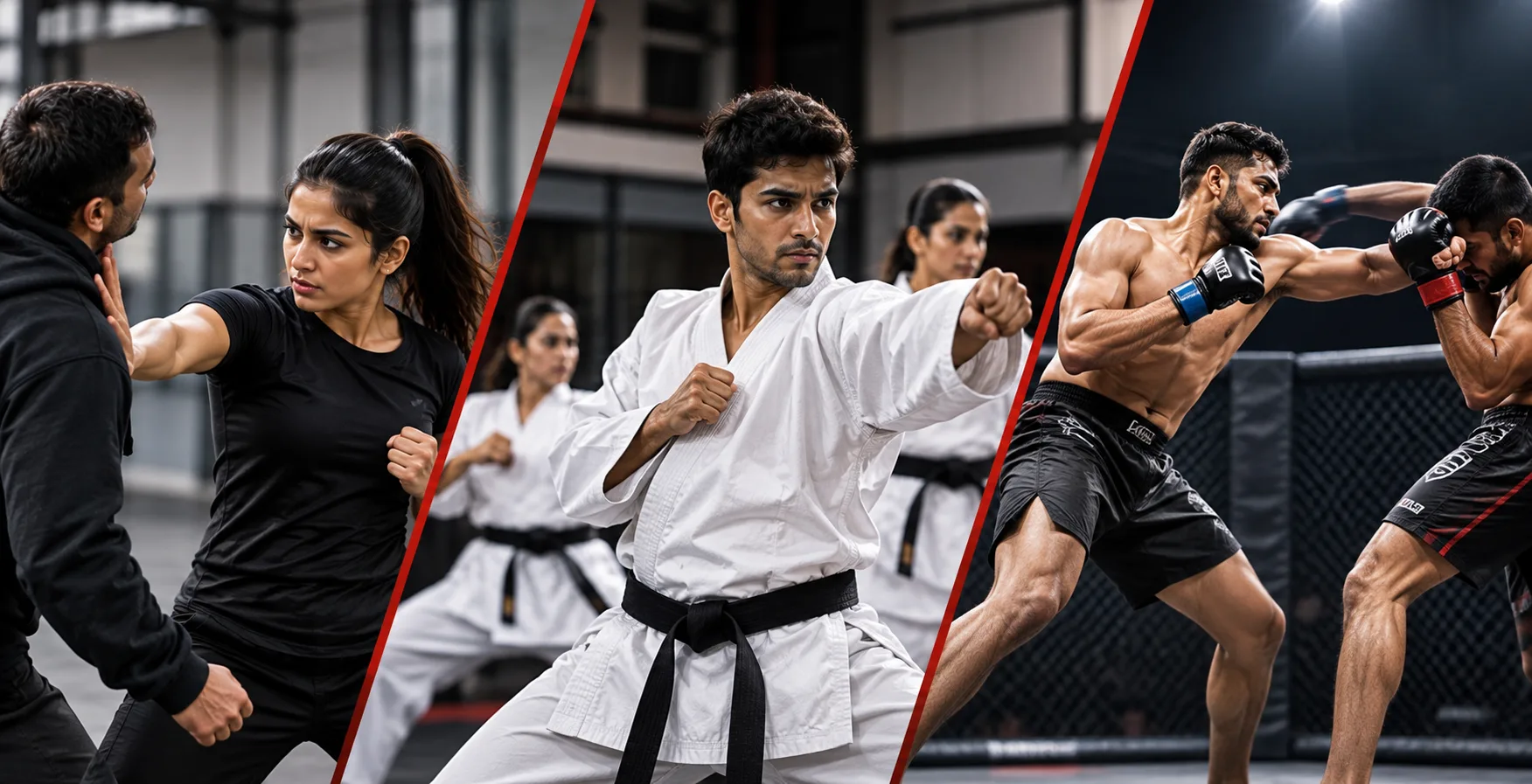
Self-Defence, Martial Arts, and Match Fighting are related, they’re all from the same family, but they are not the same. There is some overlap between the three, but there are more than enough differences that it bares looking in to.
We’re going to meet back here in three months and play a game on a playing field where the objective is to get a ball over a line to score points. Fantastic. You go away and train your backside off for three months and show up on game day ready to play…what? What game are we playing? On a field, have to get a ball over a line to score points. Is that hockey? Is that football? Is that rugby or it’s padded-up cousin American football? Is it Australian-rules rugby or the Canadian version of American football?
It looks the same on paper (playing field, ball over a line, score points), and there is even some overlap from sport-to-sport when looking at them. But if you’ve been training for one and then asked to play the other, especially when the other team have been training for the correct sport, then you’re not going to have the best time.
Before we start, we have to first look at the objective of each endeavour. I know there will be backlash (I’ve had this conversation more times than I care to remember with people, self-appointed experts, in the comments section of many a video), but the three things are very different.
02 · The Three Objectives Explained
| 🛡️ |
Self-Defence: Escape the DangerSelf-Defence; what the great Iain Abernethy defines as non-consensual violence, the objective is to escape (avoidance is best) the danger as quickly as possible while taking as little (none at all is best) damage. As Randy Couture said, “A good run is better than a bad stand.” |
| 🥋 |
Martial Arts: Learning and Self-ImprovementMartial Arts; the objective is to learn a set of physical movements so that you can demonstrate them well-enough that someone gives you a coloured belt (I will explain further down how they are to be used a vehicle for self-improvement). |
| 🥊 |
Match Fighting: Who Is the Better Fighter?Match Fighting; Abernethy defines this, not surprisingly, as consensual violence. The objective is literally solely to see who is better at fighting. Whether this be two elite-level athletes competing for a World championship in a massive stadium, whether it be a bunch of hobbyists attending a tournament at the local sports centre on a weekend, or two geniuses fighting in a car park over a sports result. |
03 · Why You Must Be Honest About What You Are Training For
Now, I’m sure a lot of people will disagree from the start with the above definitions, and that’s fine. But in my book, those people would be wrong. I have heard people tell me about how these options apply to security work (I did the doors in a city for 6-years, 85-90% of that time I was working as a one-man team on venues that really should have had more), I have had people tell me outright that self-defence is about beating the other person up. The one thing that all these people had in common was that the way they viewed what they did had come under scrutiny and essentially didn’t hold up.
Most, if not all, martial arts club will advertise that their specific style is great for self-defence. They will usually claim things along the lines of gain confidence, get fit, learn to defend yourself, and a smattering of other things. Which is fine at face-value, but once we actually stop and think about this line of marketing, we quickly will see the problem.
You cannot perform successfully if you’re not honest about the the outcome you’re training for. If you were told to train for running an Olympic race, and you spend the next three months practicing your 100-meter sprint, you’d be in trouble if you found out the actual race was a marathon, and vice-versa. But, the layperson might say, they are both running and both races, so what’s the difference?
This is where we get into the details that are vitally important;
| The objective of the training is everything. |
Is Your Club Really Teaching Self-Defence?
As an example, whatever style you’re currently training in, does it boast that it’s good for self-defence? Let’s say that it does (or at the very least you’re training under the impression that it is good for self-defence), then I will ask you this; when was the last time you worked on awareness? When was the last time you worked on how to get out of a headlock or bearhug? When was the last time the instructor went over the law (wherever you are) regarding self-defence? When was the last time you dealt with multiple-attackers? When was the last time you dealt with weapons? When was the last time you did a session in normal, everyday clothing? When was the last time you dealt with confined spaces? When was the last time you took the terrain into account?
Another question to ask you is this; with the techniques you’re learning and drilling, is the objective to subdue the other person?
Is it?
I ask because that’s not self-defence.
The objective of Self-Defence is not to be the best fighter, it’s not to be the hardest person on your street. The objective of Self-Defence is to remove yourself (and possibly those with you) from danger as quickly as possible while taking as little damage as possible. If you’re training to have a one-on-one fight with the purpose being to see who is the better fighter, than that’s Match Fighting (more on that further in the article).
04 · The Three As of Self-Defence: Awareness, Avoidance, Aggression
My syllabus as a self-defence instructor has always been based on the Three As; Awareness, Avoidance, Aggression. Basically, if we can see the danger then we can avoid it. If we can’t avoid it we need to work on our escape, which comes in the form of knocking the attacker over and fleeing (we only get physical when everything else has been exhausted; this is material for another article).
Teach What the Student Needs, Not What the Instructor Would Do
A big problem I have encountered, and continue to see, over the years is a lot of instructors teach what they consider to be Self-Defence from the perspective of what they would do, not what the student needs to do.
For example, if the instructor is a 6-foot, 210 man with decades of grappling experience, then yes I can see why his go-to strategy would be to go for a takedown and attempt to secure a submission hold or strangle/choke. But let’s say his student is a 5’2, 110 pound very timid woman, who is knew to the idea of anything physical. In what world is it smart to teach that person to engage? If we take that a lot of attacks on women perpetrated by men are sexually-motivated, then advising the woman to take the fight to the ground is doubly-ludicrous.
Not to mention the glaringly obvious point that you can’t run away if you’re essentially hugging someone on the ground (and I write that as a man with many years of Judo to my name).
Self-Defence Is Not About Beating the Other Person
Without looking it up, who right now is the Russian National Light Heavyweight Sambo champion? You don’t know. Which means you don’t know if that person stood yelling at you is the champion or not. The problem with thinking Self-Defence is about beating the other person in a fight is that there’s every chance the other person is better at fighting than you are (this is where the chorus chimes in, stating that they train and they’re well-hard etc, without ever taking into consideration that someone they meet in the real world might train harder, or have friends with them, or could be armed).
The best Self-Defence is literally don’t be where the trouble is. So why isn’t your club teaching awareness drills? Lee Morrison of Urban Combatives has a genuinely fantastic exercise for developing peripheral awareness that I suggest everyone look up.
05 · Martial Arts Is About More Than the Physical
Martial Arts is about more than the physical. I wrote at the top of this article that it is essentially the quest for many brightly coloured belts on the journey to acquiring a black one. There is of course significantly more to this. Martial Arts, when used correctly, is a quest for personal perfection that of course can never be attained. I know a lot of you will think martial arts is about defending the honour of a woman on a night out when she’s been hassled by a group of men (and it can be), but good martial arts is alerting the bouncers, getting that woman a taxi, and having the rowdy group reported to the police. What you were daydreaming about was a series of roundhouse kicks to the faces of the bad guys, right?
Good martial arts should be like a relationship; yes, it’s the physical stuff people want to know about, but it’s the rest of the circle that truly completes you. Does that person you’re in love with make you want to be a better person? Does being in love make you want to look into the things they’re interested in? Does it make you want to become a well-rounded human? That’s what martial arts should do.
The Uncomfortable Truth About Martial Arts and Real Combat
I know, without doubt, there will be people having this read to them who will think this is akin to tree-hugging hippy nonsense (these will be the same people who share memes on their social media about how it’s better to be a warrior in the garden), and they will think martial arts is all about having a skill set of fighting techniques to smash people up.
Here’s the uncomfortable truth; for the most-part, martial arts sucks as training for legitimate combat. In the martial arts, how often do you start your sparring with “What the fuck are you looking at, you fucking cunt!??! You want some do you, you fucking prick?!?!” I have seen Fifth Dans in their respective arts crumble from yelling, because in the dojo everything is nice and polite. But that is not the true nature of reality. This means that when out in the real world and faced with real, sheer naked aggression, they crumble.
| You will fight how you train, and how you train must be dictated by the objective for training in the first place. |
We know what arts/systems/styles work, due in large to the advent of Mixed Martial Arts, however, let us not get confused; MMA is still Match Fighting, and we’ll cover that in due course. However, if you can see the truth of proven combat, and still give yourself the excuse of something along the lines of, My art is too dangerous for competitive sports fighting, or My style is too deadly to try for real, then not only are you not learning anything skill-wise that would keep you safe (because theoretical skills aren’t skills at all), but you also are being failed as a martial art, because martial arts should kill the ego.
[mention burly fuckers who have never trained a day in their life having street fights]
06 · Match Fighting: Finding Out Who Is the Better Fighter
Match-Fighting is about finding out who is the better fighter. As mentioned above, whether this is world-class athletes going at it for a championship, a paycheque, and out entertainment, or whether it is two rocket-surgeons fighting around the back of the building because their team lost, this is about discovering who is better at fighting. While we’re on the subject, no sporting result has ever been changed based on the result of a fight outside a bar, so maybe knock that nonsense off in future, people?
Street Fights and the Street Filter
This is where the tool kit of techniques for one-on-one fights is needed, this is where being mediocre or better at MMA will come in to play. However, it is also worth noting that if this is under the Street Fights umbrella (Street Fight itself is such an ambiguous term that it is used incorrectly in most scenarios), what starts as a one-on-one fight quickly becomes something much more.
I have seen many a time when a fight starts between two people, but then friends get involved (this is why even something as well-rounded as MMA needs to be put through the Street Filter if we’re expecting to take that skill set into the outside world away from the dojo), it loses that mano-e-mano romanticism. I’ve seen two people fighting on the ground, someone walking past who’d had a bad night kicked the fellah on top in the ribs, and carried on walking away.
07 · How to Choose What to Train
In conclusion, to an extent because this topic of conversation can never, and should never, be put to rest, you have to be honest with yourself about why you’re training. There is no wrong answer here, by the way. If you’re training for Self-Defence I would suggest you get yourself to an actual Self-Defence club, one that doesn’t teach a martial arts style A and then tell you it will work on the streets, but one that focuses on the streets first-and-foremost.
If Your Goal Is Self-Defence
If there is no Self-Defence-specific club in your area, for just Self-Defence I would strongly recommend getting yourself into a Boxing club and Judo club once a week. This is based on most Self-Defence situations start at talking range, and if you’re bloody-good with your hands you can drop the attacker long-enough to give yourself the window of opportunity to escape. Judo is great because if punching range is lost you can go straight in with a throw, and if you end up tumbling to the ground it will give you the basics of how to get back up from under someone (for the BJJ people who are about to throw their toys out of the pram; Judo keeps that type of thing very simple, BJJ takes delight in overcomplicating everything. You know it’s true).
Remember; a good Self-Defence syllabus should be designed with the non-martial artist in mind. People who don’t want to spend decades in a dojo going through gradings. They either live in a bad area or their work puts them in front of bad people (I’ve had the joyous experience of both in my time) and they need something quick, simple, and effective (also how I describe myself on my dating profile!) that won’t take a lifetime to learn and that can be implemented by pretty-much anyone.
If Your Goal Is Match Fighting
If your training goal is Match Fighting, then you need to decide what style of Match Fighting, as in MMA or Boxing? Kickboxing or Judo tournaments? If your training is because you’re dream is to be a pro Boxer, then training in MMA won’t really help. If you’re training MMA because you want to be unbeatable on the street, cool, but keep in mind how to tweak those techniques. For example, if you’re starting point is to go for a takedown, you’re going to be in some trouble. Does that person in front of you have a weapon that you can’t see? Do they have friends/prior training?
Not to mention, when you’re in the club training, you’re on a flat surface that allows proper purchase for balance, and you’re wearing clothing that allows for a full range of movement of the limbs. What happens when you go for the slick takedown and your dress shoes slip out from under you on the highly polished hardwood floor? You fight how you train, it will become reflexive, not reactionary, meaning you won’t have the time to think it through before the body does it.
| Train wisely. |
If Your Goal Is Martial Arts
As for Martial Arts, again, there is no wrong choice as long as you’re honest about why you’re training. People often say Taekwondo is useless. Well, what if the goal is to become an Olympic Gold medal winner in Taekwondo? Then I would say that Taekwondo is actually the most-useful style possible. I have encouraged people who are elderly, who have just had surgery, who have had long periods of inactivity, to try Tai Chi. Again, it’s not going to be useful if you’re attacked, but it will still be massively beneficial for you.
08 · Three Scenarios, Three Objectives, Three Different Paths
Think of it like this;
| 🚗 | You’re walking back to the car and you get jumped. |
| 🚪 | You’re standing on the door and you’re turning away a known troublemaker. |
| 🌳 | You’re meeting someone in the park to have an arranged fight. |
Three different things, three different objectives, requiring three different paths.
🚗 Getting Jumped in the Car ParkWhen you get jumped in the car park, you need something quick and simple that will stop the attacker long-enough for you to get away (not to mention your awareness should have prevented the ambush to begin with). |
🚪 Working the DoorOn the door, you need to move the troublemaker along without a fight, the more you fight the more-likely management of the venue will see you cause all the trouble and they’ll tell the security company not to send you anymore. So you stop the troublemaker at the door, you tell them they can’t come in and give them options of several other venues that will let them in. You make-up a dress code for the night, you say it’s private hire, you say whatever is needed to get the troublemaker to find somewhere else for the evening. |
🌳 The Arranged Fight in the ParkThe arranged fight in the park. Assuming it’s honourable (not that there’s really any honour in having an arranged fight, don’t fool yourself), then finishing it as quickly as possible is the way to go. |
All very real scenarios that require very real tools to stop/prevent.
09 · Final Thoughts: Train Honestly
I’m sure you, dear reader, will have some very strong opinions on the words written above. Good. We’re discussing real-world violence, we should have strong views. However, what I would ask, is have a good think first, and ask yourself if you’re angry because I’m full of nonsense, or if you’re angry because everything I’ve written is true and it’s asking you to look at the way you’re training.
| Again, don’t train for a sprint and fool yourself that you can win a marathon. |